
I first learned about the Seven Wonders of the Ancient World years ago, and for some reason, that list never left me. There was something oddly humbling about it. I’ve always been an impatient person—the kind who wants results immediately. Even watching someone spend months on a single piece of art used to feel unimaginable to me. I just didn’t have that kind of patience.
But then I learned about structures that took not months, but decades to build.
And that completely changed things.
I remember thinking how unbelievable it was that people could dedicate so much time, effort, and coordination into something that wouldn’t even be finished within a single lifetime. At that moment, I made a quiet promise to myself: one day, I’d be able to see all of them in person.
Which brings me to something I didn’t expect.
Out of all seven wonders, only one is still standing.
Not the Hanging Gardens. Not the Statue of Zeus. Not the Lighthouse of Alexandria.
Just the Great Pyramid of Giza.
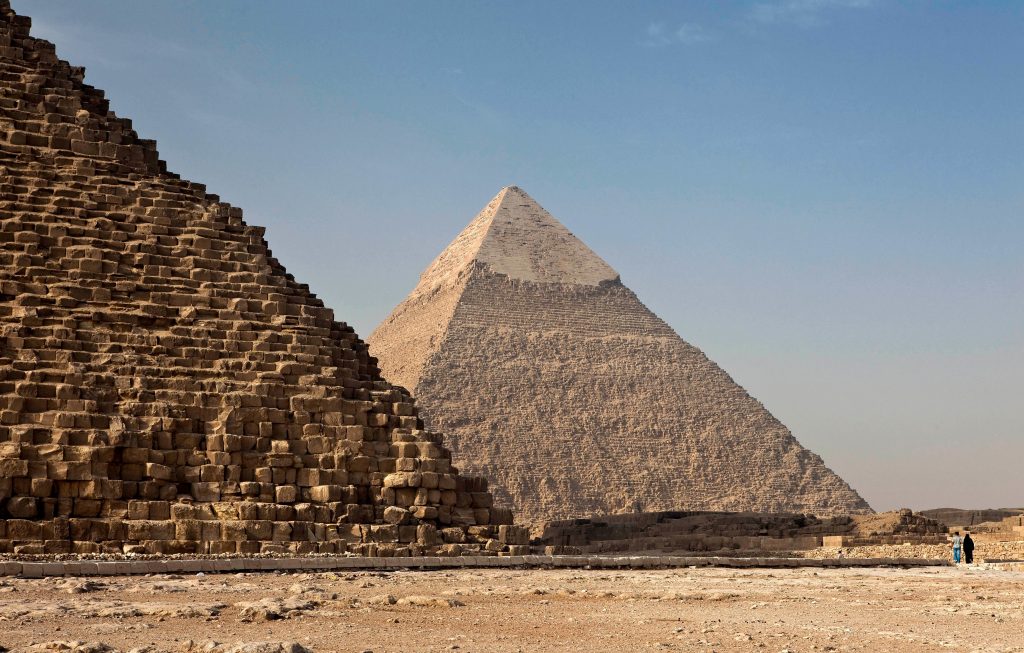
UNESCO describes it as the only surviving wonder of the ancient world, and Egypt’s Ministry of Tourism and Antiquities notes that it originally stood about 146.5 meters tall—and remained the tallest man-made structure on Earth for nearly 3,800 years. That’s the part I still can’t fully wrap my head around. The oldest one of them all is the one that survived.
Intact. Massive. Slightly defiant.
Naturally, that sent me down a rabbit hole, because at some point, I had to ask:
How did people build something like this without modern technology?
What the Pyramids Actually Were
The more I read, the more I realized something slightly uncomfortable: the pyramids don’t actually need exaggeration to be impressive.
They were monumental tombs from Egypt’s Old Kingdom, built for kings who believed they would become divine in the afterlife. But they were also not isolated triangles placed in the desert for dramatic effect. Each pyramid was part of a much larger complex, connected by causeways, surrounded by temples, and integrated into a broader religious and political system.
So yes, they were tombs.
But they were also architecture, religion, politics, and power, all stacked into one shape.
And then there’s the scale.
The Great Pyramid alone is made up of about 2.3 million stone blocks (what the f-), many weighing several tons. What surprised me even more is the precision: its sides are aligned almost perfectly with the cardinal directions, deviating by less than a degree. That level of accuracy doesn’t happen by accident – it suggests careful planning, measurement, and a deep understanding of geometry and astronomy.
At that point, it stopped feeling like “ancient construction” and started feeling like serious engineering.
Gotta Be The Aliens…Right? Right?!
I’ll admit this: as someone who grew up interested in unsolved mysteries—from the Loch Ness Monster to D.B. Cooper – I did briefly consider the idea that maybe humans didn’t build the pyramids. Not seriously… but also not entirely joking.
Because when something looks this impossible, it’s tempting to assume something extraordinary must be behind it.
So let’s address the elephant in the room now: pyramids were built by humans, not by any alien or lizardmen or anything else. And the evidence for that is actually very solid.
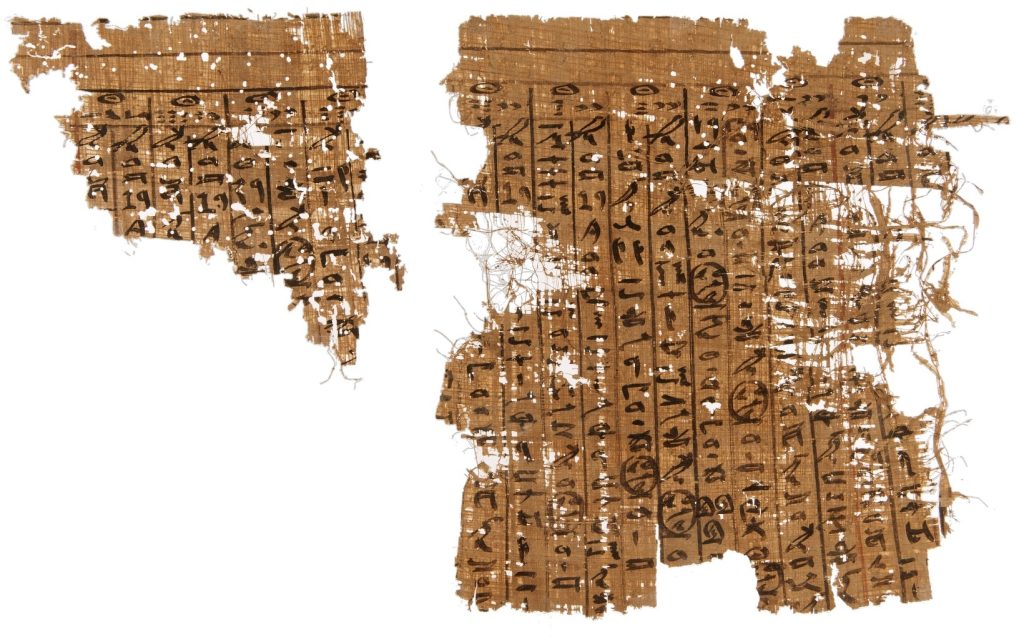
Archaeologists have uncovered a worker settlement at Heit al-Ghurab, along with nearby cemeteries. These weren’t enslaved masses working in secrecy – they were organized teams of laborers, supported with food, medical care, and infrastructure. Some of the skeletons even show evidence of healed injuries, which suggests ongoing care rather than expendable labor. Then there’s something I found especially fascinating: the Diary of Merer, published by archaeologist Pierre Tallet and transcribed publicly here. It records crews hauling stone from Tura and sailing it to Akhet-Khufu, the ancient name of the Great Pyramid, while also mentioning the official Ankhhaf, who was connected to the project.
The explanation than alien was simply bureaucracy.
And if the fact that humans built the pyramid didn’t amaze you, let me tell you something else: the the pyramid we see today isn’t the one they built. Let me explain that.

Originally, the pyramids were covered in smooth white limestone casing stones, likely quarried from Tura. These stones were polished so finely that they reflected sunlight, making the pyramids shine almost like giant mirrors in the desert. Some descriptions even suggest they looked like dazzling geometric beacons visible from miles away.
What we see now is essentially the stripped version.
Underneath that outer layer is a carefully engineered structure – limestone forming the bulk, granite reinforcing key chambers, and a layout so precise that even modern measurements still find minimal deviation.
The Burning Question: How Did They Actually Build It?
Once I really started digging into this, I realized something rather quickly: There isn’t one clear answer. Instead, there are several well-supported ideas, each explaining part of the process. The most widely accepted theory is that ramps were used to move stones upward as the pyramid was built layer by layer. But that immediately raises another question: How did the stones even get to Giza in the first place?
As mentioned above, Merer’s logbook describes repeated trips transporting limestone by boat. More recent research adds another layer to this. A 2024 study identified an ancient branch of the Nile, the Ahramat Branch, that once ran close to pyramid sites. This suggests the pyramids were not built in isolation, but along a transportation network that made moving massive materials far more manageable.
So instead of imagining stones being dragged across endless desert, it’s more accurate to imagine a system of waterways, harbors, and coordinated logistics.
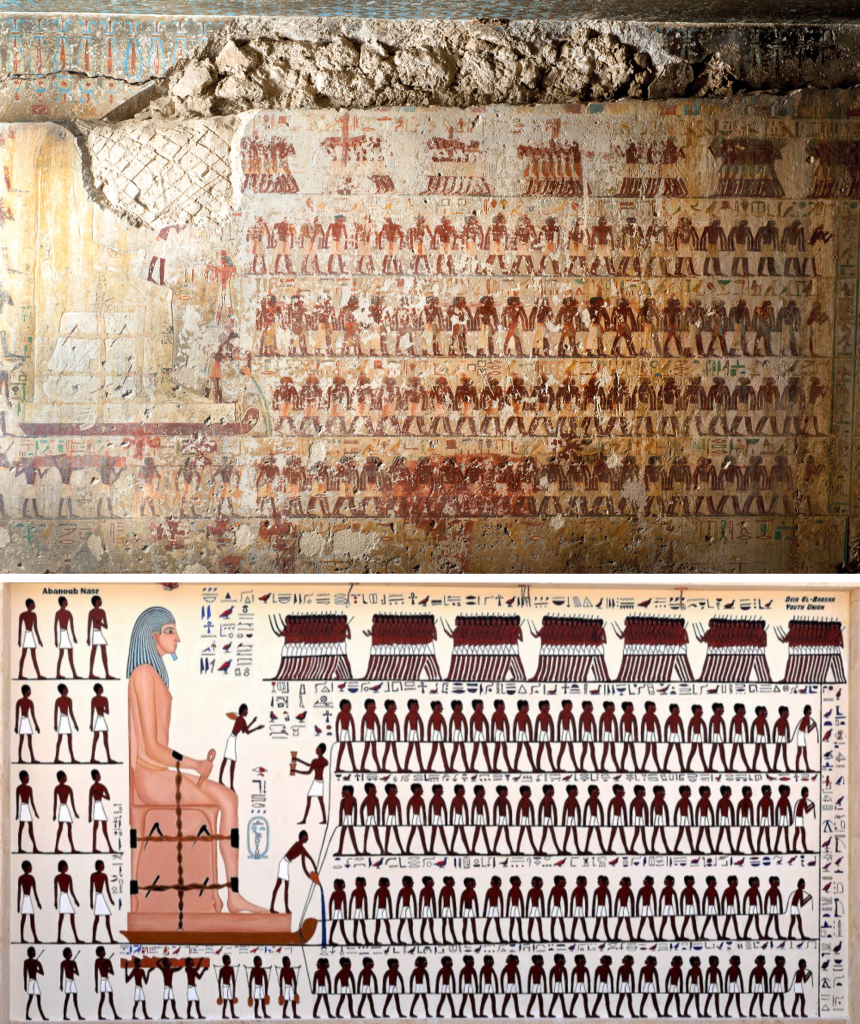
Then comes my favorite part, because it is almost… hilariously practical. Moving massive stone blocks across sand sounds like a nightmare. Dry sand builds up in front of a sled, creating resistance that makes movement incredibly difficult.
The solution? Add water.
A 2014 physics study showed that slightly wet sand reduces friction significantly, making it much easier to move heavy loads. And what makes this even better is that we actually see it depicted in ancient Egyptian art.
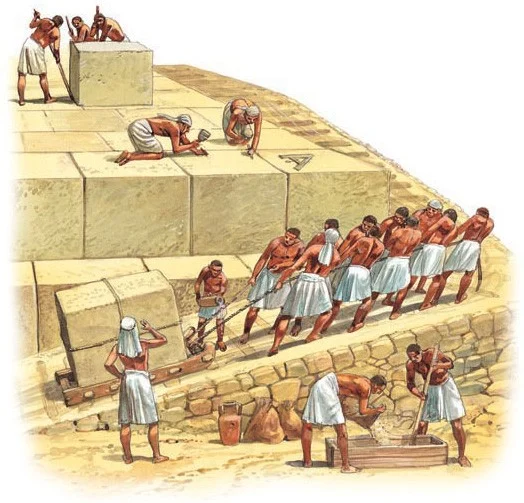
Most scholars still place ramps at the center of pyramid construction, even if they disagree on the exact design. Some propose straight ramps, others suggest zig-zagging paths or spirals wrapping around the structure. Each version has its own trade-offs: some require enormous amounts of material, while others introduce logistical challenges when turning heavy blocks. What makes this more convincing is actual archaeological evidence. At Hatnub, researchers discovered a ramp system with staircases and postholes, suggesting workers used ropes to pull sledges up steep inclines, possibly over 20% slopes.
That doesn’t prove exactly how the Great Pyramid was built.
But it does show that the Egyptians were solving real engineering problems – not just stacking stones.
One idea that keeps resurfacing is the interior ramp hypothesis, proposed by architect Jean-Pierre Houdin. Instead of relying entirely on external ramps, this theory suggests that a spiral ramp was built inside the pyramid itself as construction progressed. Some scanning results have revealed patterns that might support this idea, but it remains debated. Even experts disagree among themselves: some find it elegant, others think it introduces unnecessary complexity. Personally, I think it’s one of those theories that’s too interesting to ignore, nevertheless, not strong enough to fully accept.
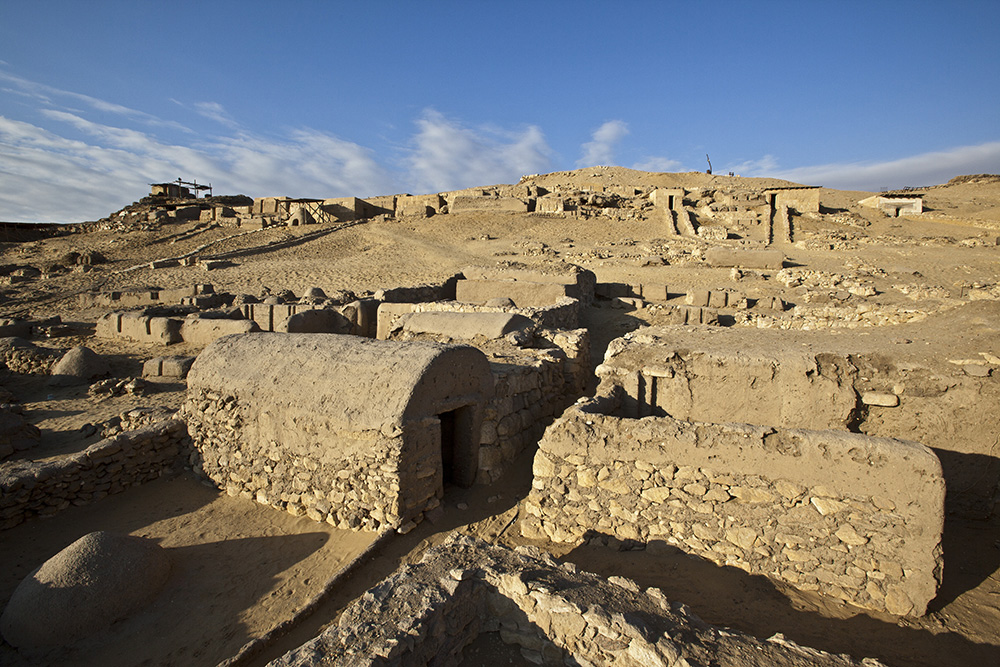
The human side of all this may be the most interesting part. As I wrote before, the workers in the project were probably not expendable. Excavations at the workers’ town suggest a purpose-built settlement full of laborers, craftsmen, managers, bakeries, warehouses, kitchens, and administrative spaces. The nearby cemetery includes overseers and skilled craftsmen, and the Egyptian Ministry’s site notes that many of the bodies showed signs of hard labor but also properly healed injuries and evidence of very good medical care. National Geographic likewise describes a workforce that was fed, supplied, and supported at scale.
Obviously, that does not make the labor easy or romantic – there was no fast-track way for this project. It just makes it legible. These monuments were not miracles dropped onto the plateau; they were projects run by people who knew how to organize labors, boats, bread, stone, and time.

So where does that leave the big question? In a satisfying but slightly annoying place: we do not have one final, universally accepted blueprint for exactly how the Great Pyramid rose course by course. But the broad outlines are much clearer than the myths suggest.
Humans built it.
They moved stone by water.
They dragged loads on sledges.
They probably relied on ramps in some form.
They coordinated huge workforces through an administrative machine powerful enough to feed, house, and direct them.
The mystery is real – but it is a human mystery, which, to me, is far more impressive.